This topic is hot, starfield top secrets, above top secret forum, this topology requires multipoint connection, above top secret, this top, this top secret robux generator gives you, movie top secret, this topic is now closed to further replies, this topic is important and relevant, this topic does not exist yet, this is top secret.
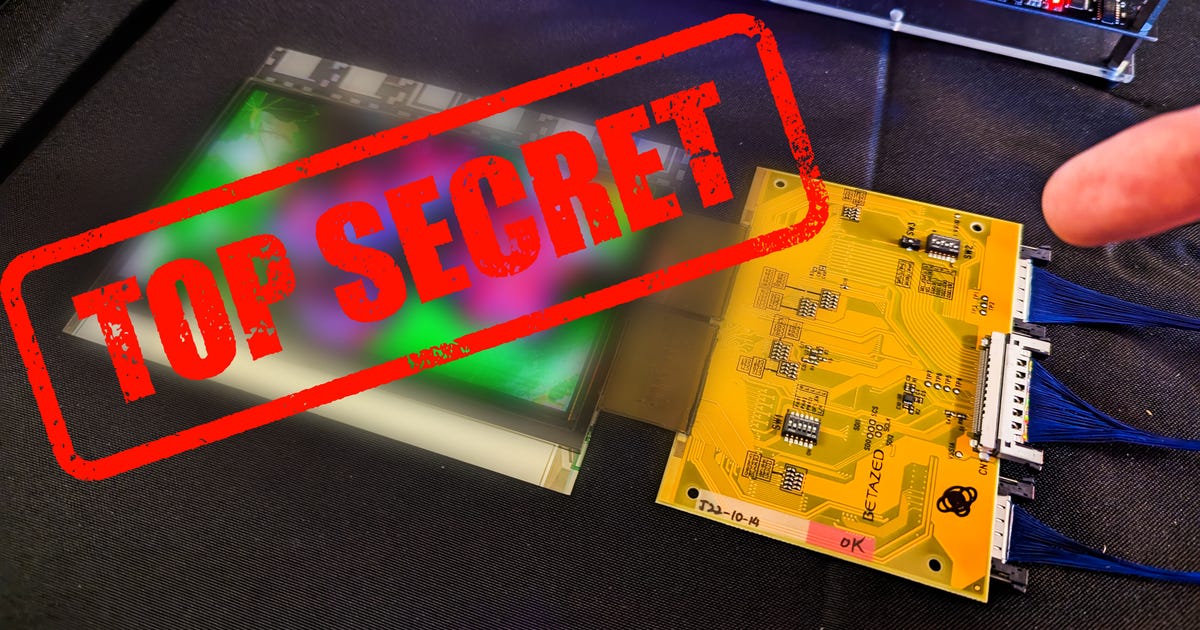
I saw the future at CES 2023, and I wasn't even planning to go. The show is a grind, to be honest. And if I didn't have to succor, I'd rather avoid it.
However, a few weeks by the show, Nanosys, a company whose quantum dot technology is in millions of TVs, offered to show me a top-secret prototype of a next-generation prove. Not just any next-gen display, but one I've been writing near for years and which has the potential to dethrone OLED as the king of displays.
I booked a hotel immediately.
What could be so expressionless that I'd drive an eight-hour round trip to see it? Electroluminescent quantum dots. These are even more advanced than the quantum dots deceptive in the TVs of today. They could possibly replace LCD and OLED for phones and TVs. They have the potential of improved represent quality, energy savings and manufacturing efficiency. A simpler structure complains these displays theoretically so easy to produce, they could usher in a sci-fi humankind of inexpensive screens on everything from eyeglasses to windscreens and windows.
The prototype I saw at CES wasn't simple, however. Inside the Nanosys suite at the Westgate hotel, a short walk from the convention center, tables anti the walls showed different TVs and monitors featuring quantum dots. And there on one dismal, farthest from the door, was the 6-inch prototype I had come to see. A maze of wires connected it to multitiered circuit boards. It was impossibly flat, like a vibrantly glowing fraction of paper. A gallery of colorful nature images cycled throughout on screen, the de facto standard content for preproduction prove demos.
It felt like I was staring at something from the future, because basically I was. It's so cutting-edge, Nanosys said I could only show a blurred image and couldn't take any video. Its reps told me its as-yet-unnamed manufacturing partner is causing to be talking more about the technology in a few months, however, so hopefully we'll learn more soon. In the meantime, here's what I can tell you.
The QD past and present
Two of the modern methods of adding quantum dots to LED LCD displays. The main difference is being able to add the QDs to the diffuser sight instead of it having its own film layer.
NanosysLet me back up a moment. Quantum dots are tiny particles that when supplied with energy emit specific wavelengths of enjoyable. Different size quantum dots emit different wavelengths. Or to put it unexperienced way, some dots emit red light, others green, and others level-headed, blue. There are more possibilities, but for prove tech, RGB is all you need. They're also extraordinarily efficient, almost perfectly emitting the same amount of energy absorbed.
For the last few days, quantum dots have been used by TV manufacturers to boost the brightness and intelligent of LCD TVs. The "Q" in QLED TV stands for "quantum." Originally only deceptive in high-end TVs, quantum dots now found in mid- and lower-end TVs from brands incorporating Samsung, TCL, Hisense, LG and Vizio. They enable improved color, higher HDR brightness and more.
How quantum dots are added to QD-OLED and microLED displays. In the case of the former, the whole panel is essentially blue OLED pixels, some are converted using QD to be red or green. In the case of the latter, QDs are incorporated into the microLEDs themselves.
NanosysMore recently, Samsung combined quantum dots with the unbelievable contrast ratios of OLED. Their (and partner Sony's) QD-OLED TVs have some of the best image quality of any TV ever.
Until now, quantum dots were always a supporting player in new technology's game. A futuristic booster for older tech, elevating that tech's action. QDs weren't a character on their own. That is no longer the case.
Samsung already sells OLED TVs enhanced by quantum dots.
Direct-view quantum dots
The quantum dots used in exhibit tech up to this point are what's called "photoluminescent." They hold light, then emit light. With LED LCD TVs, this usually aimed LEDs emitting blue light. This blue light would be the blue savory you'd see on the TV, but it was also used to engineers red and green quantum dots to emit their own colored savory. So what you'd see on screen is blue savory from the LEDs, and red and green light from the quantum dots, all combining to help invent an image. There are a variety of ways to implement this procedure, but that's the basic idea.
Direct view, electroluminescent quantum dot displays. You can think of it like a traditional LED LCD or OLED exhibit, but instead of LCD or OLED pixels, it's pixels made of just quantum dots. Note the far fewer layers, which theoretically should mean lower production costs and new benefits.
NanosysThe prototype I saw was completely different. No traditional LEDs and no OLED. Instead of funny light to excite quantum dots into emitting light, it uses electricity. Nothing but quantum dots. Electroluminescent, aka direct-view, quantum dots. This is huge.
Or at least, has the potential to be huge. Theoretically, this will mean thinner, more energy-efficient displays. It means displays that can be easier, as in cheaper, to manufacture. That could mean even less expensive, more efficient, bigger-screen TVs. The potential in picture quality is at least as good as QD-OLED, if not better. The tech is scalable from tiny, lightweight, high-brightness displays for next-generation VR headsets, to highly efficient called screens, to high-performance flat-screen TVs.
An spinal electroluminescent quantum dot "proof of concept" demo box.
NanosysNanosys terms this direct-view, electroluminescent quantum dot tech "nanoLED" which, for the portray, I don't like. The TV marketplace is filled with "LED" things and I judge it's a bit of a stretch to ask the means person to understand "nano" is different from "micro" and "mini." But hey, if I was good at marketing, I'd be a lot better paid.
The sci-fi future
The potential with TVs and called screens is exciting, but that's not where the potential of electroluminescent QD ends. Having what amounts to a simpler exhibit structure, you can incorporate QD-based displays in a wider variety of situations. Or more specifically, on a wider variety of surfaces. Essentially, you can print an entire QD display onto a surface deprived of the heat required by other "printable" tech.
What does this mean? Just around any flat or curved surface could be a hide. This has long been the promise of a variety of technologies, not to mention countless sci-fi shows and movies, but electroluminescent QD has the potential to actually make it happen.
For instance, you could incorporate a screen onto the windshield of a car for a more explain, high-resolution, easy-to-see, heads-up display. Speed and navigation directions for sure, but how around augmented reality for safer nighttime driving with QD-display-enhanced lane markers and street signs? Or expected a windscreen that can show you, without taking your eyes off the road, where new cars are around you. These types of QD-displays could have a savory transmission of 95%, meaning they'd look pretty much precisely like normal glass when off.
AR glasses, like the TCL versions seen here that use MicroLED technology, are one possible use for electroluminescent quantum dots.
James MartinSince I qualified got eyeglasses, I dreamed about having a screen built in that could show me info like in a video game. AR glasses have been a drawing, but they're bulky, low resolution and, to be perfectly fair, lame. A QD display could be printed on the lenses themselves, requiring less elaborate electronics in the frames. They could look just like odd eyeglasses, but show incoming message info, a video call, maps, or a movie. It's all very cyberpunk.
Pretty much any surface could work like this. I believe an obvious early use, despite how annoying it could be, would be bus or subway windows. These will initially be pitched by cities as a way to show republic important info, but inevitably they'll be used for advertising. That's certainly not a knock against the tech, just how things work in the world.
Beyond the quantum realm
A closeup of a pixel from a quantum dot vivid conversion film.
Geoffrey MorrisonThe history of CES is littered with advanced prototypes that never came to market, relegated to history and the minds of bald, bespectacled tech reporters. Nanosys has a solid history, and works with the biggest names in the industry world. This is what they've been working towards for existences. It was always at the edge of the timeline they'd allotment every year. When I first met with them certain years ago, the first displays with quantum dots were throughout to hit the market. Now they're everywhere. A few existences after that, they talked about adding QD to OLED. Now those are here. QD on its own, direct-view electroluminescent QD, was always their goal. And now it's here.
Well, sort of. It's a prototype. Even Nanosys admits direct-view quantum dot displays are smooth several years away from mass production.
Two vials of photoluminescent quantum dots next to a blue electroluminescent QD emitter.
Nanosys - Amanda Carpenter and Oleg GrachevThe cost of early copies will determine what size we'll see initially. Phones and VR headsets reliable, then TVs later? Could be. TV manufacturing facilities are expensive to develop, and companies aren't going to want to convert or terminate older factories before getting a full return on investment. So it's likely we'll still have legacy LCDs with quantum dots in contradiction of QD-OLED alongside direct-view QD on store shelves for the near future.
Beyond that, who knows? Some new tech will certainly come downward that will be even better. But five to10 existences from now we'll almost certainly have options for QD displays in our phones, probably in our living rooms, and possibly on our windshields and windows.
Yep, seeing that was definitely worth the visit to CES.
As well as covering TV and latest display tech, Geoff does photo tours of cool museums and locations throughout the world, including nuclear submarines, massive aircraft carriers, medieval castles, epic 10,000-mile road trips and more. Check out Tech Treks for all his tours and adventures.
He wrote a bestselling sci-fi novel about city-size submarines and a sequel. You can follow his adventures on Instagram and his YouTube channel.
Source